
What Are Tiered Royalties? A Guide to Structures and Calculations
Tiered royalties help align incentives between licensors and licensees, but they also introduce complexity in calculation, reporting, and compliance. This guide breaks down how they work, where they’re used, and what you should consider if you’re responsible for paying them.
What Is a Tiered Royalty Structure?
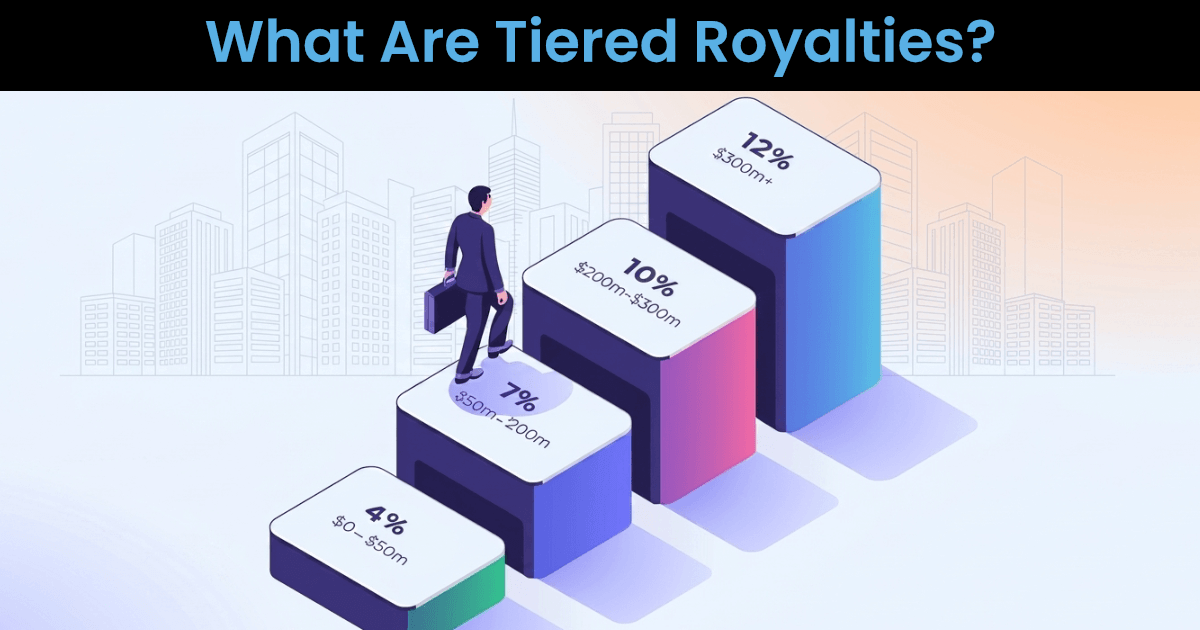
A tiered royalty structure (or “tiered royalties”) is a licensing payment arrangement in which the royalty rate changes based on predefined thresholds. The thresholds may be tied to metrics such as revenue, units sold, a time period, or some other measurable milestone. Rather than paying a fixed percentage on every dollar of sales, a tiered royalty structure applies different rates to different tiers of sales.
For example, a licensing contract may specify:
- A 5% royalty rate applied to the first $100,000 in net sales
- 7% on the next $200,000
- 10% on anything above $300,000
This structure is also known as a graduated royalty model.
How Are Tiered Royalties Calculated?
Tiered royalties are calculated using a four-step process:
- Defining the base. The royalty base is the number that the calculations are based upon. The base may be gross revenue, net sales, units sold, or some other value.
- Applying thresholds. Identifying how much of the base falls within which tier for a given royalty period.
- Calculating royalties per tier.
- Adding up the results.
In most instances, each tiered royalty rate applies only to the portion within its tier. Less commonly, a new royalty rate may be applied retroactively to all revenue once a new threshold has been reached.
What Are the Key Components of Tiered Royalties?
Tiered royalties consist of several key components that determine how payments are calculated:
- The royalty base
- Tiers or thresholds
- Royalty rates
- Reporting periods: often annual or quarterly
- Minimum royalties or advance royalties
- Measurement rules such as how currency conversions and returns and deductions will be handled
Managing Tiered Royalties Can Be Easy
MetaComet® Royalty Tracker® Makes It Simple.
Why let tiered royalty complexity slow you down when automation handles everything instantly? Save 90% of your royalty management workload. Find out how: talk to our team of royalty automation experts today.

What Is an Example of a Tiered Royalty Structure?
A tiered royalty structure can be illustrated through the example of a biotech startup that has developed a new technology and licensed it to a larger company using it to develop and sell therapeutic products.
The parties agree to the following tiered royalty structure on annual net sales:
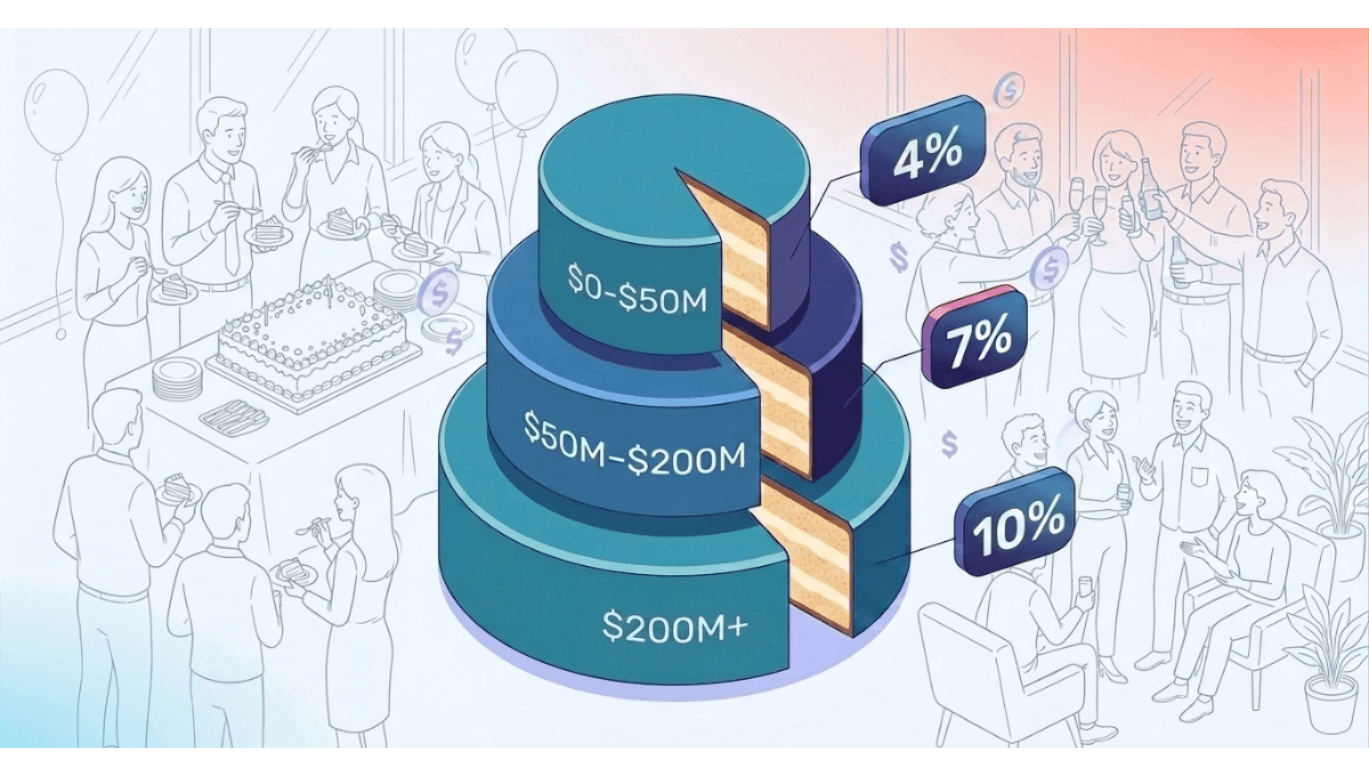
- Tier 1 applies to net sales of $0 – $50 million, with a royalty rate of 4%
- Tier 2 applies to net sales of $50M – $200 million, with a royalty rate of 7%
- Tier 3 applies to net sales of over $200 million, with a royalty rate of 10%
In the first year of sales, $250 million is generated from the licensed product. Using a cumulative model, the calculations are as follows:
- Tier 1: $50M × 4% = $2,000,000
- Tier 2: $150M × 7% = $10,500,000
- Tier 3: $50M × 10% = $5,000,000
- Total royalty owed: $17,500,000
If a threshold model were used instead, the entire $250 million would be subject to the Tier 3 rate of 10%, resulting in a $25,000,000 payment — a significant difference that underscores why the calculation method matters.
What Are the Advantages of Tiered Royalties?
For licensees and licensors alike, tiered royalties offer multiple benefits:
- Managing early-stage risk. A lower initial royalty rate reduces the financial burden during the launch phase, when revenues are uncertain and marketing investment is high. This can make licensing deals viable for companies that could not sustain high royalties from day one.
- Enabling more creative deal-making. Because both parties can see how the economics shift at different volume levels, a tiered royalty structure often facilitates negotiation. Parties can trade concessions across tiers rather than fighting over a single number.
- Protecting the licensor’s upside. If the licensee hits it out of the park, escalating tiers ensure the licensor participates meaningfully in that success.
What Are the Disadvantages of Tiered Royalties?
Tiered royalties come with several disadvantages: the tradeoff for flexibility is complexity, which comes into play at several points in the business arrangement:
- Administrative complexity. Tracking revenue against multiple thresholds across multiple reporting periods is significantly more complex than applying a flat rate. Errors in calculation can lead to underpayment, overpayment, and disputes.
- Audit and enforcement burden. Complicated audits add costs to the partnership.
- Potential for manipulation. Licensees sometimes have incentives to structure sales, timing, or reporting in ways that minimize royalties — for example, timing large deals to straddle year-end reporting periods to avoid triggering a higher tier. Robust audit rights and careful contract drafting can prevent such manipulation.
- Threshold cliff effects. In agreements using the threshold model rather than the cumulative model, crossing a tier boundary can dramatically increase total royalties owed on all revenue, creating perverse incentives to stay just below a threshold.
- Forecasting difficulty. Budgeting and financial forecasting become more complex when royalty costs are variable. This can complicate P&L modeling, especially in industries with unpredictable sales volumes.
Are There Alternatives to Tiered Royalties?
Tiered royalties are one of several approaches to structuring royalty payments, and the right choice depends on the nature of the IP, the relationship between the parties, and the commercial context. Alternatives include:
- Flat royalty rate. A single percentage applied to all sales. Simple to administer and forecast, but may quickly feel unfair if commercial outcomes diverge significantly from expectations.
- Minimum guarantee or advance + royalties. The licensee pays an upfront amount, and royalties apply after that minimum or advance is recouped.
- Fixed license fee. A one-time lump sum payment for perpetual rights to use the IP. Eliminates ongoing royalty obligations and administrative burden, but requires accurate upfront valuation and removes the licensor’s participation in ongoing commercial success.
- Milestone payments. Lump-sum payments triggered by specific events such as regulatory approval, first commercial sale, or achieving a sales target. Often combined with royalties rather than used as a standalone alternative.
- Royalty cap. A flat rate with a maximum total royalty obligation. Once the cap is reached, no further royalties are owed. This is especially common in patent licenses where the licensor wants ongoing revenue but the licensee wants certainty of total cost.
- Revenue sharing. Rather than a royalty on sales, the parties share net profits or revenues directly. This aligns interests more closely but requires greater transparency into the licensee’s financial operations.
In practice, many licensing agreements combine multiple approaches, such as a tiered royalty structure combined with milestone payments and a minimum annual royalty floor.
How Can Tiered Royalties Be Automated?
Tiered royalties are conceptually straightforward but operationally complex. Automation with a tool like MetaComet’s Royalty Tracker means the difference between days spent reconciling contracts and spreadsheets, and the ability to generate accurate royalty statements in minutes.
An automated royalty system will:
- Store all royalty terms in a structured system
- Process sales data, returns, and currency rates
- Apply tier logic and other complex rules automatically
- Flag errors and inconsistencies
- Generate accurate royalty statements, payment files, reports, and transparent audit trails
- Provide forecasting features
Royalty automation increases speed, accuracy, and real-time visibility, reducing stress and frustration for the teams managing complex tiered royalty structures, and allowing businesses to scale.
See how royalty automation makes calculating tiered royalty structures easy: schedule a demo with the MetaComet team.

David Marlin is the President and Co-Founder of MetaComet® Systems, a prominent provider of royalty automation tools. Since founding the company in 2000, David has spearheaded the development of a suite of best-in-class systems that effectively facilitate royalty processes for nearly 200 publishers. David has also served as the chair for The Book Industry Study Group’s Rights Committee and Digital Sales Committee.
Before establishing MetaComet Systems, David served as a technology consultant for renowned publishers, collaborating with notable companies such as Random House, Penguin, HarperCollins, Holtzbrinck, Macmillan, Scholastic, Time Warner, and many others. David holds both an MBA and a BA from Columbia University in New York.
Contact Us
"*" indicates required fields