No Results Found
The page you requested could not be found. Try refining your search, or use the navigation above to locate the post.

The page you requested could not be found. Try refining your search, or use the navigation above to locate the post.
For any business based on intellectual property, IP rights function as currency. They can be bought, sold, licensed, and assigned. They appear on balance sheets as assets, can be used as collateral for loans, and represent transferable economic value.
For IP rights to have worth, they must be managed properly, and in accordance with the underlying contracts that define who controls them, how they may be monetized, and how the IP creators and rightsholders will be compensated.
This guide walks through what contracts and rights management is, how it works in practice, where it tends to break down, and how modern software is changing the discipline. Whether you’re a rights manager at a publishing house, a licensing director at a brand, or an IP counsel at a tech company, the fundamentals are the same.
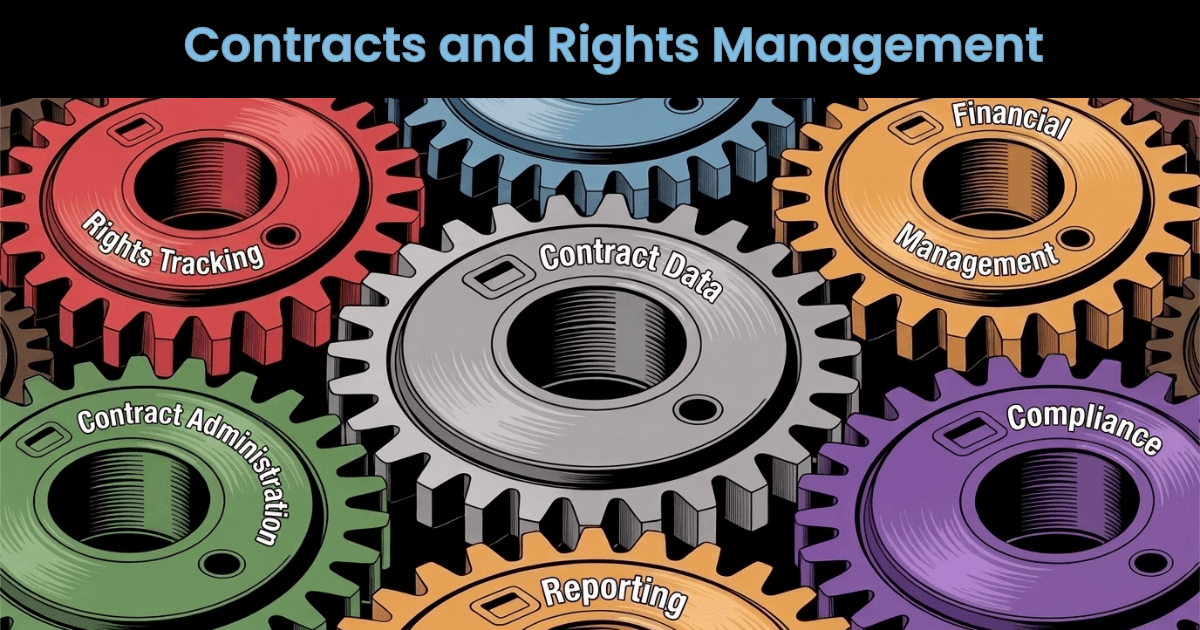
Contracts and rights management is the discipline of administering the legal agreements that govern how intellectual property is used, by whom, where, when, and on what financial terms. It encompasses everything from drafting and negotiating licensing contracts, to tracking the rights granted under those contracts, to collecting and distributing the revenue those rights generate.
A piece of intellectual property has economic value only because the law gives its owner the right to control how it’s used. Contracts are the instrument through which that control gets exercised. Rights management is the operational layer that makes sure the contracts actually function as intended over time.
Done well, contracts and rights management protects the value of an IP portfolio, ensures compliance with legal obligations, maximizes revenue, and prevents the kind of disputes that end up in court. Done poorly, it leads to missed payments, expired licenses being used without authorization, double-licensed exclusivity, lost revenue, and litigation.
A functional contracts and rights management operation has several interlocking components, including:
Each component depends on the others. You can’t calculate royalties accurately if you don’t know which rights were granted. You can’t audit compliance if you can’t quickly retrieve the relevant contract clauses. You can’t make smart licensing decisions if you can’t see, in aggregate and detail, how your portfolio is performing.
Every rights agreement moves through a predictable lifecycle, and understanding that lifecycle is essential to managing the process well.
Most rights management failures happen because one or more of these lifecycle stages is poorly tracked. A contract gets executed but is never properly entered into the system. Royalty statements arrive but never get reconciled. A term expires but the system never flags it. Each gap creates risk.
Contact us for a no-pressure, half-hour meeting to discuss how you can optimize your systems to deliver more rights revenue today.

A licensing contract typically contains a predictable set of provisions. Understanding these provisions is the foundation of rights management, because every operational decision flows from what the contract says. Common licensing contract provisions include:
A well-managed rights operation extracts the operational data from each of these clauses and tracks it as structured information, not as text buried in a PDF that someone must search every time a question comes up.
The term “rights” is doing a lot of work in any IP context, because the underlying grants vary enormously by industry and asset type.
The complexity multiplies when a single asset generates multiple rights streams that are licensed to different parties. A novel might be licensed for hardcover, paperback, ebook, and audiobook to one publisher; for film adaptation to a studio; for translation into a dozen languages to local publishers; and for merchandise to a brand licensee. Each of those licensees has obligations to the rights holder, and the rights holder needs a system to track all of it.
Several distinct roles typically participate in rights management, even if a small organization combines some of them in one person.
Coordination across these roles is one of the persistent challenges of rights management. Information that lives separately in legal’s contract files, finance’s accounting system, and operations’ tracking spreadsheets needs to stay synchronized — and frequently doesn’t.

Licensees are parties to a contract with substantive obligations, such as:
Licensees who take these obligations seriously generally maintain healthy long-term relationships with rights holders. Licensees who don’t tend to find themselves on the receiving end of audits, disputes, and termination notices.
Meanwhile, the licensor doesn’t simply collect checks while the licensee does all the work. Licensor obligations include:
Licensors need to meet their obligations with the same rigor as licensees. Approval-response deadlines, delivery dates, payment-forwarding schedules, IP maintenance dates, and exclusivity boundaries all need to be visible to the team.
In theory, rights management is straightforward: read the contract, do what it says. In practice, complexity creeps in from many directions.
The result is that even rights operations staffed by capable, experienced professionals find themselves spending enormous amounts of time on administrative work that could, in principle, be automated.
Several practices distinguish well-run rights operations from chaotic ones:
For most of its history, rights management ran on paper files, spreadsheets, and the memory of long-tenured staff. That model is breaking down under modern volumes and complexity, and dedicated rights management software is rapidly becoming standard in serious operations.
Modern platforms transform the discipline in several ways, including:
Practices that simply weren’t possible with manual administration — granular tracking across thousands of titles, real-time reconciliation, predictive analytics on portfolio performance — become routine when the underlying operations are handled by software. Rights operations that adopt modern tooling can manage portfolios many times the size of what their predecessors handled, with better accuracy and more strategic insight.
If you’re evaluating how your own rights operation could benefit from modern tooling, the first step is mapping your current process against the lifecycle and components described above. Wherever you find yourself relying on a single person’s memory, a sprawling spreadsheet, or a manual reconciliation, you’ve found a place where technology can almost certainly help.
Another resource is MetaComet’s free rights assessment. Contact us for a no-pressure meeting to learn how you can optimize your systems to deliver more rights revenue today.

David Marlin is the President and Co-Founder of MetaComet® Systems, a prominent provider of royalty automation tools. Since founding the company in 2000, David has spearheaded the development of a suite of best-in-class systems that effectively facilitate royalty processes for nearly 200 publishers. David has also served as the chair for The Book Industry Study Group’s Rights Committee and Digital Sales Committee.
Before establishing MetaComet Systems, David served as a technology consultant for renowned publishers, collaborating with notable companies such as Random House, Penguin, HarperCollins, Holtzbrinck, Macmillan, Scholastic, Time Warner, and many others. David holds both an MBA and a BA from Columbia University in New York.
"*" indicates required fields