No Results Found
The page you requested could not be found. Try refining your search, or use the navigation above to locate the post.

The page you requested could not be found. Try refining your search, or use the navigation above to locate the post.
Rights management software is an essential tool for book publishers, literary agents, and any content rights holders who want to maximize the income they generate from their intellectual property.
Retail book sales are the most familiar source of publishing revenue, but book production is labor-intensive and engenders a high cost of goods. In comparison, the cost of licensing out the rights to a book title or product will be negligible, and the profit margin will be much higher. That’s why it makes good business sense for any publisher to supplement their retail program with a robust rights program, and to manage their rights with professional, purpose-built software that makes it easy and efficient to track and manage their rights availability, sales records, and income.

Rights management software is a tool that helps book publishers, literary agents, and other content rights holders or rights managers keep track of the rights they control, have sold, and have available to sell. The most useful software will also help them track rights-related payments (both received and overdue).
It’s important to note that this type of software is distinct from digital rights management (DRM) software, which is a technology that uses encryption to protect digital files from unauthorized use.
Rights and royalty management software are often bundled together in an integrated system, but the two solve different problems. Rights software tracks who controls a work’s rights, what has been sold, to whom, and under what terms. Royalty management software calculates and pays out what’s owed once a rights deal is in place.
In other words, rights software manages the deal, and royalty software manages the money that flows from it. Most publishers use both, since a licensing agreement created in a rights system becomes the input for royalty calculations downstream.
Rights management software generally falls into a few categories, distinguished by scope and deployment.
Standalone rights platforms focus exclusively on tracking rights availability, licensee relationships, and contract terms, without handling royalty calculations. Bundled rights and royalty systems combine rights tracking with royalty automation in a single platform, which reduces double data entry for publishers who need both functions.
Another approach to rights management software includes it within a broader enterprise-wide platform that also includes functionality such as title and project management. These types of systems do not have the advanced rights management features of a purpose-built system. The rights and royalties functions are usually an afterthought.
Cloud-based systems, now the industry standard, are hosted and updated by the vendor and accessed through a browser. Legacy on-premise systems are installed and maintained locally instead.
Software also varies by industry focus. Some platforms are built specifically for book and content publishers, while others serve broader IP licensing needs across sectors like biotechnology or entertainment.
Publishers, literary agents, and other content rights holders need rights management software to track and sell the rights they control. Anyone who owns or controls the rights to a copyrighted work, or who represents the rightsholder, and wishes to leverage that work to generate revenue, will benefit from using such a system. That could include rights executives, rights managers, or other book publishing rights professionals, as well as literary agents.
Rights management software centralizes and automates the tracking of a publisher’s or agent’s rights portfolio, from availability through sale to payment. It provides access to all the information needed to:
It acts as a custom-tailored data repository that supports rights professionals throughout the entire rights management process.
Rights management is not a job for the faint of heart. Rights professionals frequently wrestle with challenges, including:
These environmental challenges can lead to:
Fortunately, well-designed software can solve these problems and ease frustration by integrating with other publishing systems, providing clear and accurate information, saving time, and surfacing revenue opportunities.

The key functions of rights management software are tracking rights availability, managing contracts and licensee relationships, and surfacing revenue opportunities and overdue payments.
It must provide transparency into all of a company’s available content rights and restrictions, and serve as a reliable repository for all information about:
Some of the key contract terms that must be included are:
Various content types, media, and forms of derivative works may be covered, such as:
The software should be flexible and customizable regarding how the users want to define the above content types and terms (especially territories), particularly since we’re living and working in a rapidly changing world. It should allow the bundling of any combination of regions, languages, formats, etc. in a single agreement.
The right software needs to include robust reporting and analytics tools and the ability to surface or flag available sales opportunities, contracts that are due to expire or renew, and any compliance issues.
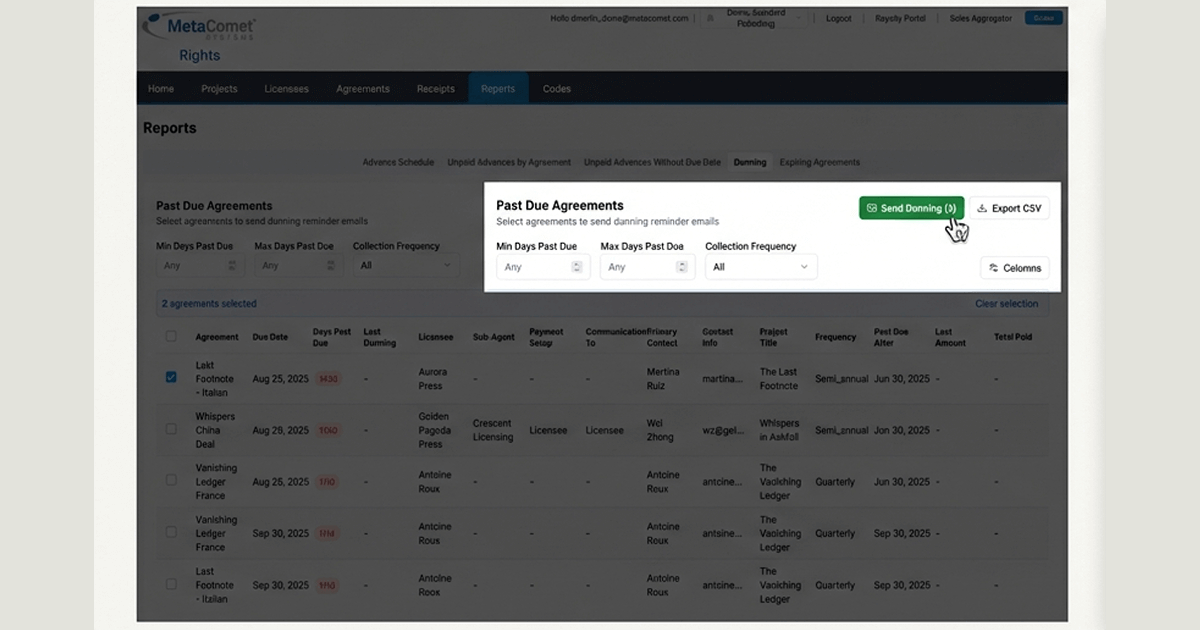
Another key feature is the ability to highlight late statements and advance or royalty payments and generate and send dunning letters automatically.
Finally, the ideal rights management system will offer tools for importing and exporting data, or APIs or other integrations, allowing interoperability with other publishing software such as title management, sales, accounting, and royalty management systems.
The primary benefit of using rights management software is that it enables rights professionals to sell more rights and generate more income. It gives them the information they need to leverage existing deals, discover new opportunities, and achieve new insights that can inform and improve sales strategy.
Another benefit that can be measured in increased revenue is the ability to see and collect on late payments.
Rights software also enables a smarter valuation of assets (in order to optimize pricing) as well as company valuation (in the event of a merger or acquisition).
When rights managers have their licensing information at their fingertips, they’re equipped to provide better service to their customers and business partners, build trust and relationships, and be better positioned for future sales.
Using a good rights management system means never facing a copyright infringement claim or accidentally duplicating a license. Not only is this good for a company’s reputation, but it also reduces liability risk and therefore, insurance costs.
By supporting a more efficient rights workflow, rights software enables licensing at scale, speeds up communications and deal-closing, and frees up hours in the day so rights pros can spend more time selling.
The main uses of rights management software are checking rights availability before a sale, preparing licensee-facing sales materials, and recovering overdue payments.
Here are a few scenarios showing how rights management software can change the licensing game for different types of publishers.

MetaCometⓇ Systems provides the best rights and royalty management software in the publishing business. MetaCometⓇ Rights delivers all of the functionality that publishers and literary agents need, and the complementary Royalty TrackerⓇ program completely automates the royalty management process.
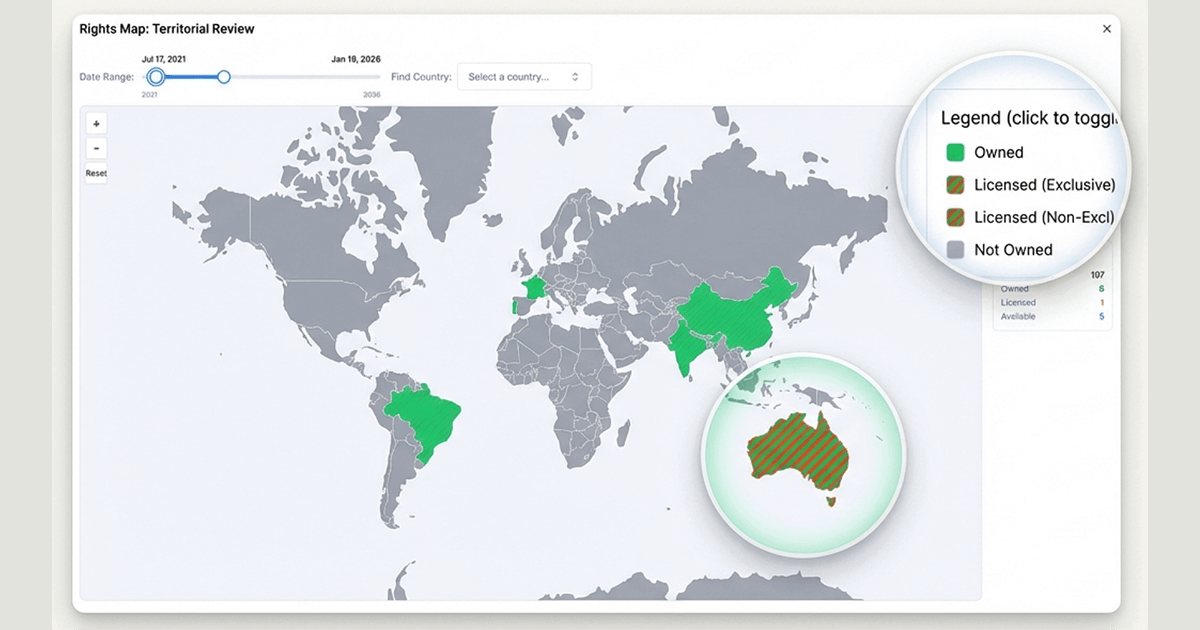
MetaCometⓇ Rights was designed specifically for rightsholders to maximize the revenue they can earn from licensing out rights. It’s quick and simple to implement and use, and flexible enough to adapt to whatever terms your contracts contain, no matter how complex. It organizes extremely granular agreement information and displays it in screens, maps, and reports that are user-friendly and easy to read.
Royalty TrackerⓇ is an indispensable tool for calculating and paying royalties, useful to book publishers, distributors, agents, and other IP licensees.
MetaCometⓇ Rights and Royalty TrackerⓇ are designed to be modular, so you can invest in only one component if you don’t need both, or combine the two for a single, optimized rights and royalty management system. Sales Aggregator and Royalty Portal are two optional add-ons that can extend your royalty processing capabilities.
MetaCometⓇ Systems is known for its outstanding customer support and user-friendly software products. The company has been dedicated to rights and royalty solutions since 1999. MetaCometⓇ software is designed to easily integrate with other platforms, including finance, title management, DAM, and ERP systems. The cloud-based software is certified SOC 2 Type 2 secure and subject to rigorous third-party testing.
No other software company is better suited to help you manage your publishing rights and royalties in today’s complex global environment and media ecosystem. Contact us to see MetaCometⓇ Rights and Royalty TrackerⓇ in action, and learn how you can increase your rights revenue while decreasing your workload, errors, and stress.

David Marlin is the President and Co-Founder of MetaComet® Systems, a prominent provider of royalty automation tools. Since founding the company in 2000, David has spearheaded the development of a suite of best-in-class systems that effectively facilitate royalty processes for nearly 200 publishers. David has also served as the chair for The Book Industry Study Group’s Rights Committee and Digital Sales Committee.
Before establishing MetaComet Systems, David served as a technology consultant for renowned publishers, collaborating with notable companies such as Random House, Penguin, HarperCollins, Holtzbrinck, Macmillan, Scholastic, Time Warner, and many others. David holds both an MBA and a BA from Columbia University in New York.
"*" indicates required fields