No Results Found
The page you requested could not be found. Try refining your search, or use the navigation above to locate the post.

The page you requested could not be found. Try refining your search, or use the navigation above to locate the post.
Royalty negotiation sets the foundation for every licensing relationship that follows. Get it right, and both licensor and licensee share in a deal that rewards performance for years to come. Get it wrong, and even a promising partnership can turn into a source of ongoing friction and financial strain.
Whether you’re a licensee negotiating your first agreement or a seasoned dealmaker refining your approach, understanding how royalty negotiation works and how to prepare for it can mean the difference between a contract you’re happy with and one you’re stuck renegotiating. Below, we break down what it involves and how Royalty Tracker® can help you negotiate with data-backed confidence.

Royalty negotiation is the process by which licensors and licensees agree on the rate, structure, and terms governing payments for the use of licensed intellectual property. It typically covers the royalty percentage or flat fee, the revenue base the rate applies to (gross or net sales), payment frequency, minimum guarantees, advances, and audit rights.
Because so many variables affect the outcome, royalty negotiation is rarely a single conversation about a percentage. It’s a broader discussion about how risk, reward, and administrative burden will be shared between the parties for the life of the agreement.
Licensees should prepare for royalty negotiation by researching typical rates in their industry. From there, they should clarify their own sales projections and identify which contract terms matter most to their business. Industry benchmarks give licensees a realistic starting point. A licensee entering a consumer goods deal, for example, should know that rates commonly fall between 3% and 10%, while a franchise agreement might run from 4% to 12%.
Beyond benchmarking, licensees benefit from modeling several sales scenarios before sitting down at the table. Knowing how a proposed rate performs under conservative, moderate, and optimistic projections helps licensees understand exactly what they’re agreeing to, and where they have room to negotiate.
It’s also worth identifying priorities in advance. Some licensees care most about keeping the royalty rate low; others would rather secure exclusivity, a longer license term, or more favorable audit provisions. Walking into negotiation with a clear sense of what matters most makes it easier to trade concessions strategically rather than reactively.
Common royalty negotiation strategies include the offer of tiered royalty structures, minimum guarantees, and advance payments, each of which shifts risk and reward differently between the parties. Tiered structures increase the royalty rate as sales pass certain thresholds, aligning incentives so that both licensor and licensee benefit as the product performs.
Minimum guarantees protect the licensor by ensuring a baseline payment regardless of actual sales, while advances give licensees room to invest in bringing a product to market before royalties are owed. Many negotiations also address the scope and exclusivity of the license, since exclusive rights typically command higher rates than non-exclusive ones.
Sophisticated negotiators also treat the revenue base itself as a negotiable term. Royalties can apply to gross or net revenue, and different deductions may be allowed along the way. Both factors can shift the effective rate significantly, even when the stated percentage stays the same.
Successful royalty negotiation depends on preparation, clear communication, and a willingness to think beyond the headline rate. A few practices consistently lead to stronger outcomes.
Start with data, not assumptions. Grounding a negotiating position in real sales history or credible industry benchmarks builds trust and makes proposals harder to dismiss. Focus on the full deal, not just the percentage. A slightly lower rate paired with a longer term, broader territory, or lighter reporting burden may be worth more than a marginally higher rate with restrictive conditions attached.
Build in flexibility where possible. Tiered rates, renewal options, and defined review periods allow both parties to adjust as circumstances change, rather than locking in terms that may not hold up over the life of the agreement.
Finally, put everything in writing. Verbal understandings about how a rate was calculated or what counts as a deduction won’t survive a dispute; the agreement itself needs to spell out every relevant term.
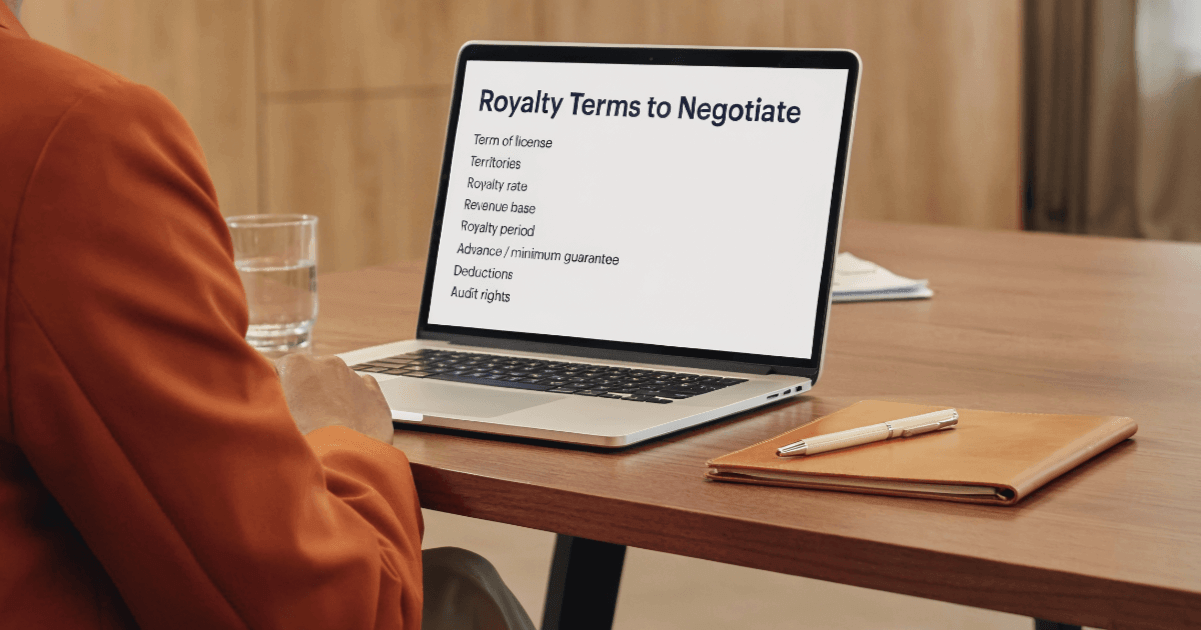
Common pitfalls in royalty negotiations include vague definitions of the revenue base, unclear audit rights, and royalty structures that don’t account for future growth. When a contract fails to define exactly what counts as gross or net sales, or which deductions are permitted, licensors and licensees often end up with different interpretations of the same agreement. That gap can lead to underpayment, disputes, or costly audits.
Licensees sometimes overlook how minimum guarantees or royalty advances will be recouped, agreeing to terms that look manageable on paper but create cash flow strain in practice. Licensors, meanwhile, may set a flat rate that doesn’t scale well if sales far exceed expectations, leaving value on the table. Skipping a clear audit clause is another frequent misstep; without one, either party may have limited recourse if reported sales figures come into question later on.
A strong rights and royalty system is one of the most valuable assets a licensor or licensee can bring to the negotiating table. Every prior deal holds information: which rates performed well, which minimum guarantees were realistic, which contract language led to disputes. Without a system that captures and reports on that history, every new negotiation starts closer to scratch.
Good reporting turns past deals into a negotiating advantage. A licensor who can pull up exactly how similar titles, products, or technologies performed under past agreements walks into a negotiation with real leverage, not just instinct. A licensee who can see how their own royalty obligations have trended over time can negotiate future terms with a much clearer sense of what they can sustainably afford.
Royalty reporting also surfaces broader trends that individual contracts can’t show on their own. These patterns only become visible when data from many agreements is tracked in one place. Portfolio-wide reporting can reveal which royalty structures consistently outperform expectations, or which terms tend to trigger disputes. That kind of insight helps both parties propose terms grounded in evidence rather than guesswork. It also makes it easier to spot when a proposed rate or structure is out of step with what similar deals have actually delivered.
Software solutions support royalty negotiation by giving both parties access to accurate historical sales data and modeling tools that show how proposed terms would perform in practice. Rather than negotiating from estimates or outdated spreadsheets, licensors and licensees can reference real royalty history, reserve balances, and advance recoupment figures pulled directly from their royalty management system.
Once an agreement is reached, that same software eliminates the risk of misapplying complex negotiated terms. MetaComet’s Royalty Tracker® stores contract terms exactly as negotiated, including tiered rates, minimums, and advances, then applies them automatically to every sales report that comes in. That accuracy carries the trust built during negotiation forward into every statement, payment, and audit that follows.
Ready to put your next negotiated agreement into practice? Contact MetaComet to see how Royalty Tracker® and our other tools can help you manage it with confidence.

David Marlin is the President and Co-Founder of MetaComet® Systems, a prominent provider of royalty automation tools. Since founding the company in 2000, David has spearheaded the development of a suite of best-in-class systems that effectively facilitate royalty processes for nearly 200 publishers. David has also served as the chair for The Book Industry Study Group’s Rights Committee and Digital Sales Committee.
Before establishing MetaComet Systems, David served as a technology consultant for renowned publishers, collaborating with notable companies such as Random House, Penguin, HarperCollins, Holtzbrinck, Macmillan, Scholastic, Time Warner, and many others. David holds both an MBA and a BA from Columbia University in New York.
"*" indicates required fields