No Results Found
The page you requested could not be found. Try refining your search, or use the navigation above to locate the post.

The page you requested could not be found. Try refining your search, or use the navigation above to locate the post.
Book sales data is the foundation of many critical publishing processes. Publishers rely on it to measure title performance, calculate royalties, manage inventory, forecast revenue, evaluate distribution channels, and make decisions about acquisitions and marketing.
Yet book sales data is rarely simple. A publisher may receive files from distributors, retailers, wholesalers, ebook platforms, audiobook services, direct-to-consumer stores, international partners, and other sources. Each organization may report sales differently, use different product identifiers, and provide data on a different schedule.
Before publishers can act on sales information, they must collect, standardize, validate, and reconcile it. The larger and more diverse the publisher’s sales network becomes, the more important a structured sales data management process is.
This guide explains what book sales data includes, why it can be difficult to manage, how it supports royalty calculations, and how publishers can improve accuracy and efficiency through automation.
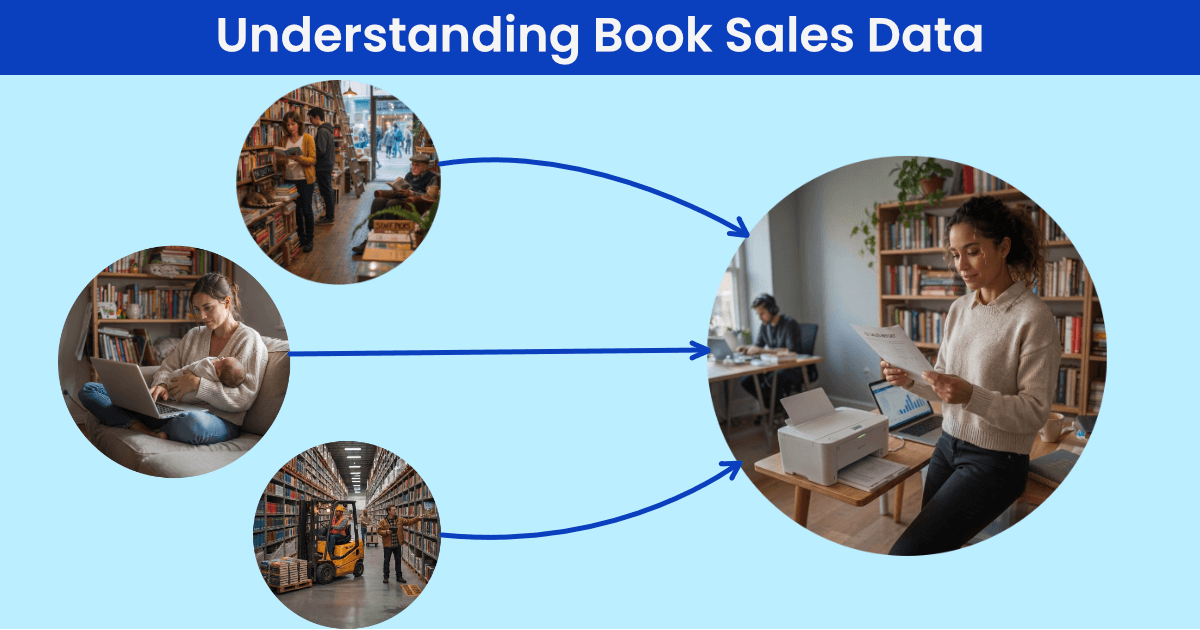
Book sales data is the information publishers receive about transactions involving their books and other products. It may include sales of print books, ebooks, audiobooks, journals, subscriptions, digital content, bundles, merchandise, or licensed products.
At its most basic, a book sales record identifies:
A sales record may contain dozens of additional fields. These can include the ISBN or product ID, title, format, customer, retailer, distributor, territory, currency, list price, selling price, discount, tax, commission, shipping charge, return quantity, and net receipts.
Sales data may be delivered as a spreadsheet, CSV file, fixed-width text file, electronic data interchange feed, API connection, PDF, or other report downloaded from a retailer or distribution platform.
The data format usually originates outside the publisher’s own systems. This means publishers must understand not only the information itself but also how each reporting partner defines and organizes it.
The exact fields a publisher needs depend on its business model, distribution arrangements, and author contracts. However, useful book sales data should generally include enough information to identify the product, classify the transaction, calculate revenue, and determine the appropriate royalty treatment.
Important fields commonly include:
Each transaction should include a reliable product identifier, such as an ISBN, SKU, product code, or internal title ID. The data should also indicate the title, edition, format, and imprint when applicable. Correct product identification is essential. A hardcover, paperback, ebook, and audiobook version of the same title may each have different prices, royalty terms, and contributors.
Publishers should receive the transaction date, reporting period, transaction type, number of units, and whether the transaction represents a sale, return, refund, adjustment, promotional copy, or other activity. The difference between a sale and an adjustment is especially important when calculating royalties and reconciling financial reports.
A complete sales record may include:
The fields required for royalty calculations depend on whether the author is paid based on list price, net receipts, units, profit, or another contractual basis.
Publishers benefit from knowing whether a transaction came through a wholesaler, retail chain, independent bookstore, library supplier, direct sale, institutional account, subscription service, online marketplace, or another channel.
Channel information helps publishers analyze profitability and may also affect royalty calculations. Some contracts specify different royalty rates for direct sales, special sales, exports, deep-discount sales, or subscription revenue.
Territory and country data may be necessary for evaluating international performance, applying contract terms, converting currencies, and determining which rights or agreements apply. A sale in the United States may be treated differently from a sale in Canada, the United Kingdom, Europe, or another territory.
Most publishers do not receive sales data in one clean, standardized format. Instead, they receive multiple files from multiple sources, each with its own structure and terminology. One distributor might use the field name “Net Sales.” Another might call the same concept “Publisher Proceeds.” A retailer may report negative quantities for returns, while another source places returns in a separate column. One source may identify books by ISBN-13, while another uses an internal SKU.
Publishers may spend significant time reformatting files before the data can be loaded into an accounting, royalty, or business intelligence system. This manual work is not simply inconvenient. Every copied formula, renamed column, deleted row, and reformatted date creates another opportunity for error. In many houses, the entire process lives in one person’s head and one person’s spreadsheets. When that employee leaves, institutional knowledge walks out the door with them.
Inconsistent formats, manual data entry, complex calculations, multiple currencies – why process book sales data manually when Sales Aggregator standardizes and automates everything? Eliminate errors and reclaim your time. Get your free consultation now.

Sales data is one of the primary inputs in the royalty calculation process. The publisher combines transaction data with the terms in each author, illustrator, editor, translator, agent, or licensor agreement.
A royalty system must determine which contract applies to a particular sale and then apply the correct rules.
For example, an author agreement might provide:
The royalty calculation process may also need to account for advances, reserves against returns, returns from previous periods, taxes, fees, currency conversions, agent commissions, and multiple contributors.
To calculate royalties accurately, the publisher must be able to connect each transaction to the correct:
A seemingly small data issue can have a significant downstream effect. If an ebook sale is incorrectly classified as a print sale, the wrong royalty rate may be applied. If a title’s ISBN is not recognized, transactions may be excluded from the royalty statement entirely.
Even established publishers can experience sales data problems. Some originate with external partners, while others are introduced during internal handling.
A sales file may contain an ISBN or product code that does not match the publisher’s records. This can occur because of formatting differences, missing leading zeros, inactive ISBNs, bundles, or distributor-specific identifiers.
Unmapped transactions may be omitted, assigned to the wrong title, or require time-consuming manual investigation.
A revised report may be imported in addition to the original report rather than replacing it. Files may also overlap in their reporting periods.
Without duplicate controls, the publisher could overstate sales, revenue, and royalties.
Returns may appear as negative quantities, negative revenue, separate transaction codes, or adjustments. If the return logic is misunderstood, sales and royalties can be overstated or understated.
Some reports provide gross revenue but not net receipts. Others may combine distributor deductions, taxes, shipping, or commissions in ways that are difficult to interpret.
This is particularly important when royalties are calculated on net receipts.
International sales may be reported in local currency, converted currency, or both. Using the wrong exchange rate or conversion date can create discrepancies between royalty reports and accounting records.
A report labeled “June sales” may include transactions processed in June rather than sales that occurred in June. Different partners may use invoice dates, shipment dates, transaction dates, or payment dates.
Publishers should understand which date drives each report and apply that logic consistently.
A reliable sales data process should be repeatable, documented, and auditable. The following practices can help publishers improve data quality and reduce manual work.
Publishers should avoid maintaining separate, disconnected copies of sales information across individual spreadsheets and departments.
A centralized system makes it easier to track what has been imported, identify corrections, maintain product mappings, and preserve an audit trail.
Document how files from each source should be processed. The procedure should identify:
Standard operating procedures reduce dependence on individual employees’ knowledge.
The publisher should retain the original version of every sales file before making changes. This makes it possible to trace a transaction back to its source, investigate discrepancies, and support audits.
Sales data should be checked for missing identifiers, invalid dates, unknown transaction types, duplicate records, unexpected currencies, unusual quantities, and mathematical inconsistencies. It is usually safer to stop and investigate questionable transactions first.
Imported totals should be compared with distributor summaries, retailer reports, invoices, remittance statements, bank deposits, or general ledger records.
Publishers should reconcile both financial totals and units whenever possible.
A publisher may need to map multiple external product codes to a single internal product record. These mappings should be stored and reused rather than recreated manually every reporting period.
When a distributor sends a corrected file, the publisher should have a clear process for replacing, reversing, or adjusting previously imported transactions.
The goal is to preserve a transparent history without counting the same sale twice.
A strong process does not require employees to inspect every row manually. Instead, the system should identify exceptions that require human review.
This allows publishing staff to focus on unfamiliar products, missing fields, unusually large amounts, duplicate records, and other potential problems.
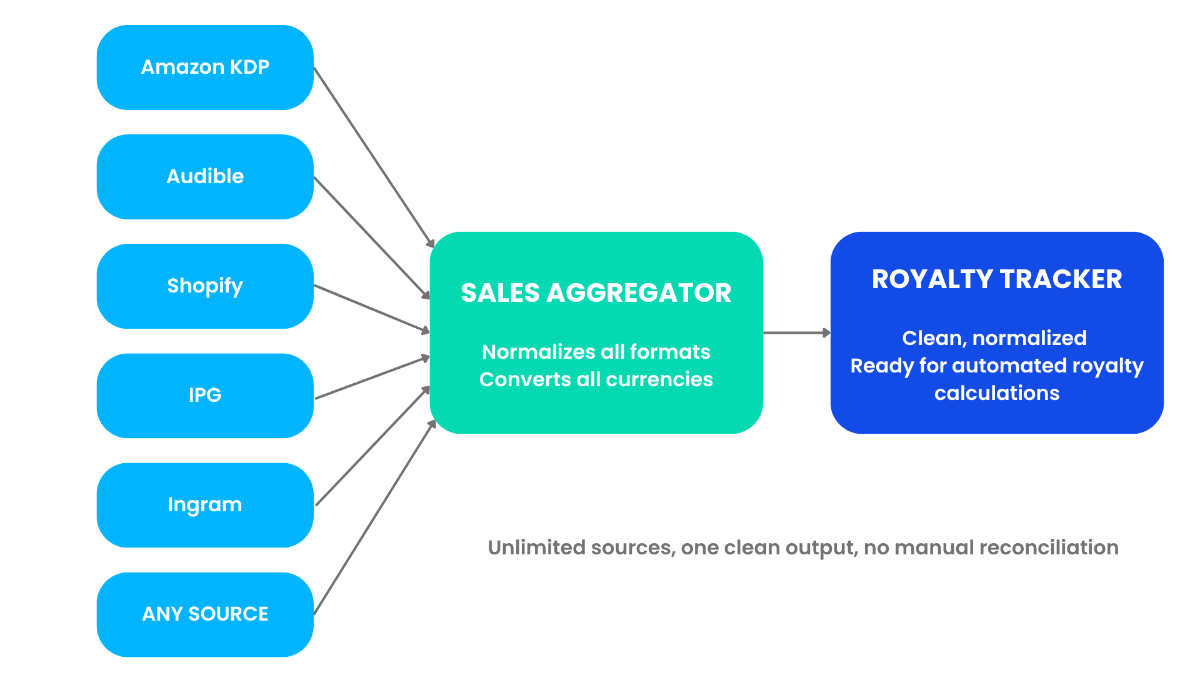
Automation can replace many of the repetitive tasks involved in receiving and preparing book sales data.
A sales data automation system may:
The greatest value of automation is not only that it works faster. Automation creates consistency and allows for greater complexity.
A defined import rule treats the same type of transaction the same way every time. Validation rules can identify problems before they affect royalty statements. Saved mappings reduce repeated manual work, while audit records make it easier to understand how the data was processed.
Automation can be especially valuable for publishers that work with a growing number of distributors, operate internationally, process high transaction volumes, or calculate royalties for many titles and contributors.
However, automation does not eliminate the need for oversight. Publishers still need employees who understand their contracts, sales channels, accounting practices, and reporting relationships. The goal is to let software handle predictable data preparation while people review exceptions and make informed decisions.
Although royalty processing is a major use of book sales data, standardized data can support many other business functions.
Publishers can use it to analyze:
Clean sales data can help editorial teams evaluate acquisitions, marketing teams measure campaigns, sales teams manage accounts, finance teams forecast cash flow, and executives identify growth opportunities.
When data remains scattered across incompatible spreadsheets, these analyses become much harder to produce and trust.
MetaComet® Sales Aggregator helps publishers turn sales information from multiple sources into organized, royalty-ready data. It ingests and standardizes sales files from distributors, retailers, digital platforms, and other reporting partners.
Validation and error reporting help teams identify missing information, invalid values, unmapped products, and other issues before the data moves into royalty processing. Reusable import configurations and product mappings reduce the need to reformat the same type of file each period. Automated currency conversion eliminates another tedious step of the process.
Sales Aggregator also serves as a central repository for historical sales data, so institutional knowledge never walks out the door. Audiobook producer John Marshall Media used it to scale from 125 to 600 titles and from 25 to 113 distribution platforms.
Once the data has been prepared, it can flow into MetaComet Royalty Tracker®. Royalty Tracker® applies the appropriate contract terms, including royalty rates, advances, escalators, reserves, deductions, and other agreement conditions. Publishers can then generate royalty reports, payment files, and statements from a centralized system.
Together, these tools help publishers:
MetaComet gives publishing teams a more controlled and efficient way to manage the data on which their royalty and financial processes depend.
If you’re ready to stop wrestling with spreadsheets, see how Sales Aggregator and Royalty Tracker work firsthand: schedule a demo with MetaComet and find out why publishers have trusted its royalty solutions for more than 25 years.

David Marlin is the President and Co-Founder of MetaComet® Systems, a prominent provider of royalty automation tools. Since founding the company in 2000, David has spearheaded the development of a suite of best-in-class systems that effectively facilitate royalty processes for nearly 200 publishers. David has also served as the chair for The Book Industry Study Group’s Rights Committee and Digital Sales Committee.
Before establishing MetaComet Systems, David served as a technology consultant for renowned publishers, collaborating with notable companies such as Random House, Penguin, HarperCollins, Holtzbrinck, Macmillan, Scholastic, Time Warner, and many others. David holds both an MBA and a BA from Columbia University in New York.
"*" indicates required fields